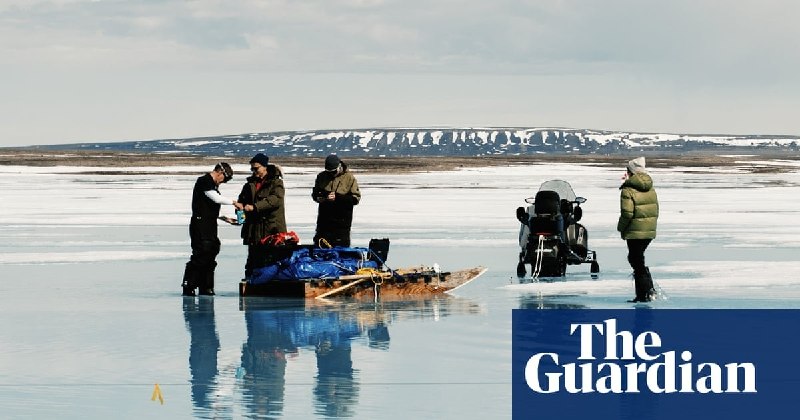
"Refreeze the Arctic" — that is the goal scientists have set for themselves. Researchers in the Real Ice project already have their first results, and they are prompting climate scientists to take a closer look at the technology.
Last winter, near the Canadian town of Cambridge Bay, the team brought about 50,000 tons of seawater to the surface through holes drilled in the ice. In those conditions, it froze almost instantly, increasing the ice thickness by about 50 centimetres.
The effect was clearly visible in summer. While the ice around it rapidly turned into blue meltwater ponds, the experimental area remained white. It could even be seen clearly in satellite images. What is more, the researchers found an unexpected bonus: the artificially formed ice was lighter than natural ice and likely reflects more sunlight.
Over the past 45 years, the area of Arctic summer sea ice has shrunk by about 40%, and open water absorbs much more solar energy than ice. A feedback loop emerges: the less ice there is, the faster the ocean warms and the more rapidly melting continues.
Scientists are now studying how the technology affects ecosystems, the salinity of the ice and microorganisms. At the same time, engineers are developing autonomous underwater drones that could one day do this work without human involvement.
Of course, an extra half-metre of ice will not stop climate change on its own. But the experiment has shown for the first time that an idea that only recently seemed almost mad is indeed worthy of serious scientific study.