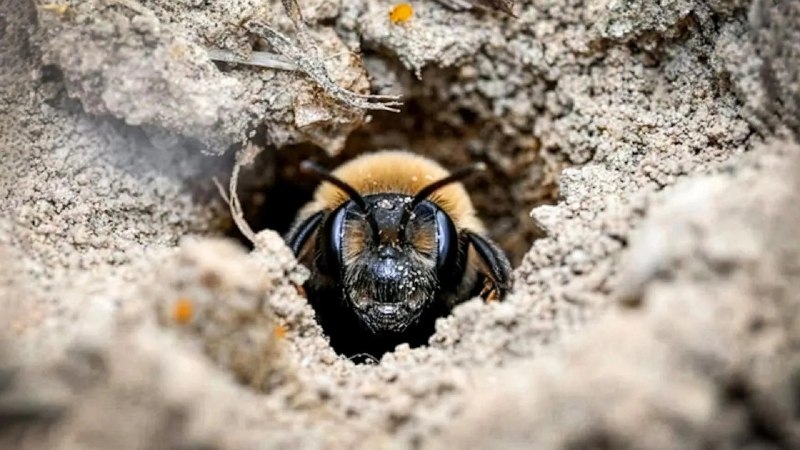
A routine walk through East Lawn Cemetery in Ithaca, New York, led to an unexpected scientific discovery. In spring 2022, Rachel Fordyce, a staff member in Cornell University’s entomology lab, noticed an enormous number of bees, collected several specimens, and handed them over for study.
Scientists identified them as solitary ground-nesting bees of the species Andrena regularis. Follow-up research showed that beneath the cemetery lies one of the largest known colonies of these bees. According to the researchers’ estimates, an average of 5.5 million individuals live on an area of about 6,000 square meters, and the real number may range from 3 million to 8 million.
According to the scientists, similarly huge settlements probably exist elsewhere as well. People simply usually do not suspect that a whole insect metropolis may be hidden beneath an ordinary lawn. Unlike familiar honeybees, about 75% of all bee species in the world do not live in hives at all. They prefer solitary lives and dig burrows in the ground. Each female independently builds small underground chambers, stores pollen and nectar there, lays eggs, and then her parental duties are over. There is no complex social organization and no honey production. But for nature, such bees are no less important.
Historical data indicate that these bees have lived there for more than a century. The cemetery turned out to be an ideal environment thanks to sandy soil, the absence of pesticides, and minimal human interference. Sometimes the best way to help nature is simply not to interfere.