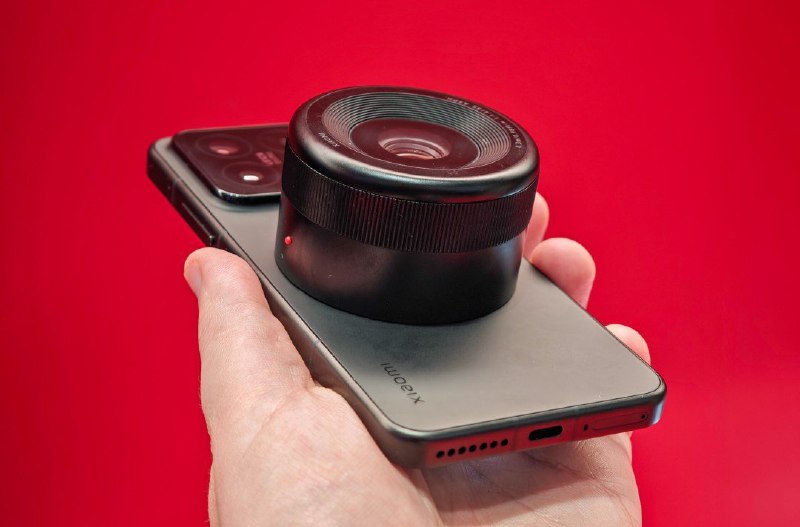
Xiaomi and Realme have presented smartphone concepts with a fundamentally new approach to mobile photography. Both developments share the goal of increasing the physical size of the sensor and using interchangeable optics — something that traditionally distinguishes professional cameras.
Realme showed a smartphone with the ability to mount removable lenses via an M-mount attachment. The device uses a large Sony sensor without a built-in lens, and the lens connects mechanically. Only manual lenses are supported; autofocus is absent. The solution makes the device bulkier, but gives users a choice of portrait or telephoto optics.
Xiaomi proposed a modular system for the Xiaomi 15: an external block with its own large sensor — larger than in any mass-produced smartphone — magnetically attaches to the rear panel. LaserLink technology is used to transmit power and data, autofocus is supported, and photos can be written quickly to the phone’s memory. The module is easy to attach and remove.
Of course, questions remain. The new mounts are incompatible with existing lenses, and the balance between portability and “almost professional” quality is fragile. But the very fact that major brands are experimenting in this direction suggests that the smartphone is beginning to claim a role as a full-fledged creative tool.