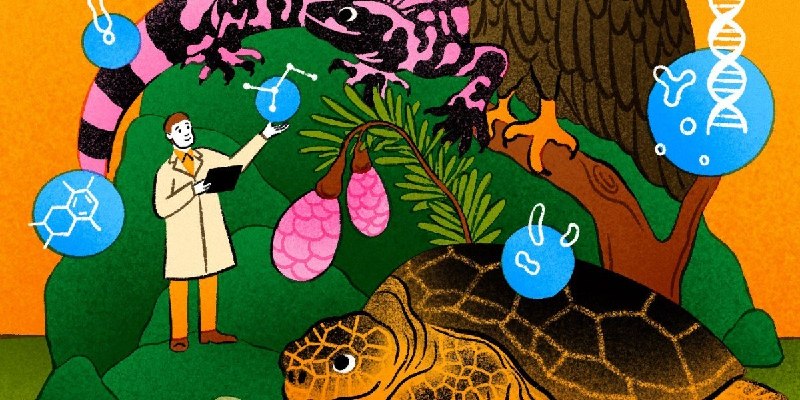
After nearly twenty years at Merck, chemist Tim Cernak decided to use modern drug-development technologies not only for humans, but for wildlife as well. He is now working at the University of Michigan to develop “conservation chemistry” — the creation of drugs originally designed for specific animals and plants. The problem is that many wild species today are treated with human medicines that often turn out to be too toxic. For example, a standard drug against fungal infection in frogs can be almost as dangerous as the infection itself.
To search for new medicines, the team uses Google DeepMind’s AlphaFold AI. It helps quickly predict protein structures, and then robotic laboratories carry out up to 1,500 chemical reactions a day, speeding up the search for promising compounds. The researchers have already worked with white-tailed eagles suffering from avian flu, sea turtles with contagious tumors, and Gila monsters affected by parasites. Incidentally, research on the Gila monster laid the groundwork for an entire class of GLP-1 drugs. In the end, that scientific line led to medicines such as Ozempic and Wegovy. In addition, the scientists are developing a highly precise insecticide to protect hemlock trees from invasive pests.
Cernak’s idea is simple: medicines should be developed specifically for the species that truly need them. Of course, no medicine alone will save endangered species. Without habitat protection, anti-poaching efforts, and a change in how humans relate to nature, that will not happen. But if modern technologies can give biologists one more effective tool, that is already a significant step forward.