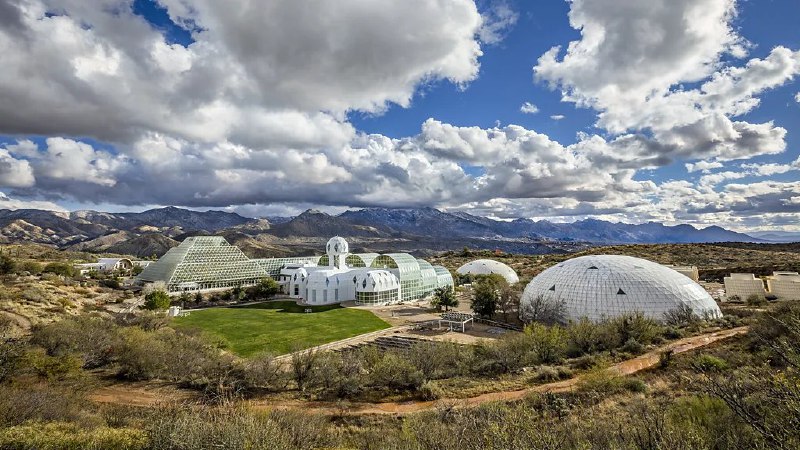
In 1991, a group of eight enthusiasts sealed themselves inside a huge glass dome in the middle of the Arizona desert for two years, with no right to leave. The goal was to find out whether humans could survive in a fully closed ecosystem. That is how “Biosphere 2” was born — a true miniature planet Earth, with jungles, desert, marshes, and even an ocean with coral inside.
It did not go perfectly. Oxygen levels fell, carbon dioxide rose, pollinators died out. People ran around the greenhouse with paintbrushes, pollinating plants by hand, ate modest harvests, and somehow kept their spirits up. When the situation had to be rescued with oxygen supplied from outside, critics declared the project a failure. Yet years later it turned out that it had not been in vain.
Scientists now say that “Biosphere 2” helped us understand just how fragile ecosystems are, and how important it is to account for every element. For example, it became clear that without wind trees weaken, and soil can begin to “consume” oxygen.
Today, “Biosphere 2” is a major climate laboratory. Scientists simulate droughts, heat, and rising ocean acidity inside it and observe how ecosystems respond. The experiment showed that creating nature from scratch is incredibly difficult. And that Earth is our only true biosphere, which should not be taken for granted.