The Moon was long considered almost completely isolated — a cold, airless rock. However, a new study shows that the connection between Earth and its satellite may be much closer. Scientists at the University of Rochester have proposed a new explanation for the origin of volatile substances in lunar regolith brought back by Apollo missions. It was previously thought that nitrogen, helium, water, and carbon dioxide reached the Moon mainly thanks to the solar wind, but the observed concentrations did not fully fit this model.
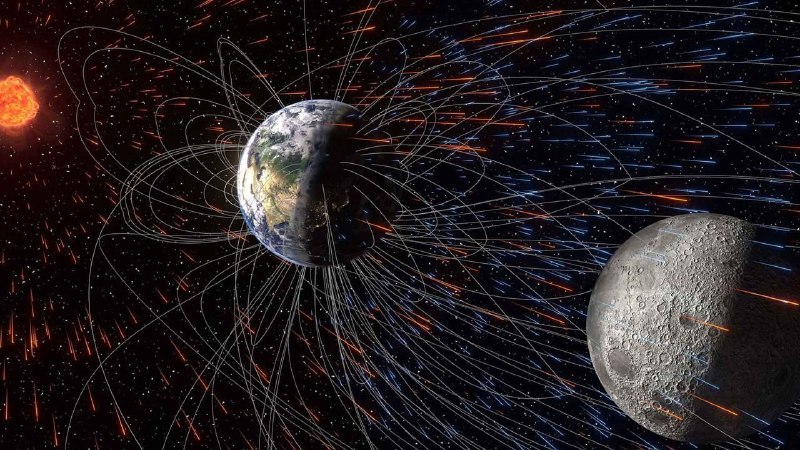
Using computer modeling, the researchers showed that Earth’s atmosphere could have been an additional source of these substances. The analysis showed that the planet’s strong magnetic field does not prevent particles from escaping; instead, it directs them toward the Moon along extended magnetic field lines.
Geological data indicate that a powerful magnetic field existed on Earth as early as 3.7 billion years ago, which means that the transfer of atmospheric particles could have taken place throughout most of the planet’s history. This makes lunar soil a potential archive of the evolution of Earth’s atmosphere.
The results are also important for future lunar bases: volatile substances contained in the regolith, including water, could become a valuable resource for long-term human presence on the Moon.