Scientists from Johns Hopkins University and the University of St Andrews have shown in controlled experiments for the first time that a great ape is capable of imagination and “pretend play”.
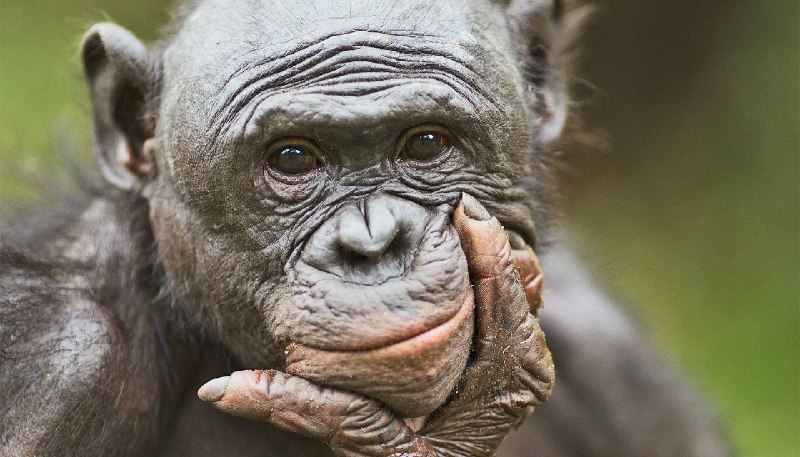
Kanzi, a 43-year-old bonobo long known to researchers for his complex behavior, handled nonexistent objects as if they were really in front of him. In the first experiment, a researcher “poured” imaginary juice into two empty cups, then “poured” it out of one and asked where the juice was. Kanzi most often correctly indicated the right cup, even when the cups were switched. In the second test, a real drink stood next to the imaginary one, and Kanzi almost always chose the real juice. That is, he was not simply joining in the game, but clearly distinguished the imaginary from the real. In the third experiment, the same logic was repeated with imaginary grapes, and the result was again consistent.
Similar episodes in apes had previously been observed in the wild and in captivity, but there had been no strict proof. This new study is the first reproducible demonstration of such an ability. For science, this is important because imagination and pretend play are considered part of complex thinking.
The authors of the study suggest that the roots of this ability may have emerged as far back as 6–9 million years ago in the common ancestor of humans and modern great apes. This makes the boundary between human and animal minds less rigid and once again draws attention to ethical questions about how they are treated.