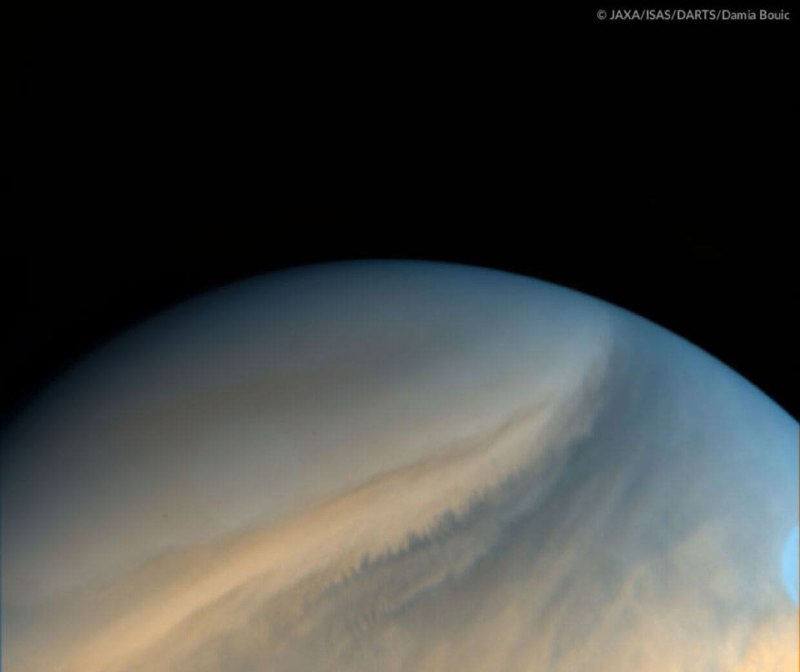
Scientists from Sweden and the United States have reexamined data collected in 1978 by the Pioneer Venus 2 probe and found that there may be six times more water in Venus’s atmosphere than previously believed.
It had initially been assumed that the clouds at an altitude of 50–70 km were made almost entirely of sulfuric acid. However, modern analysis methods showed that, during the probe’s flyby, its instruments were temporarily blocked by compounds containing water in bound form — hydrated sulfates of iron and other metals. Under high temperatures, these compounds broke down, and the instruments underestimated the amount of moisture present.
It is now estimated that as much as 62% of the cloud material consists of bound water, while sulfuric acid accounts for only 22%. The rest is metal compounds that likely arrived with cosmic dust.
The idea of Venus’s clouds being poisonous now looks less straightforward. In addition, if the conditions in the atmosphere are less harsh than previously thought, this opens a new possibility: the existence of microscopic life. On Earth, for example, there are extremophilic bacteria that thrive even in acidic conditions.
Even old scientific data can provide completely new answers when viewed with modern methods.