An international team of astronomers has tackled one of the key mysteries of space: where most of the ordinary matter—made into stars, planets, and everything around us—has been hiding.
Talk of “missing” matter began in the 1990s, when scientists started measuring the cosmic microwave background precisely. When they counted stars, galaxies, and clouds of gas, they found only half of the expected matter. For years, the search relied on X-ray and ultraviolet telescopes, but it did not succeed.
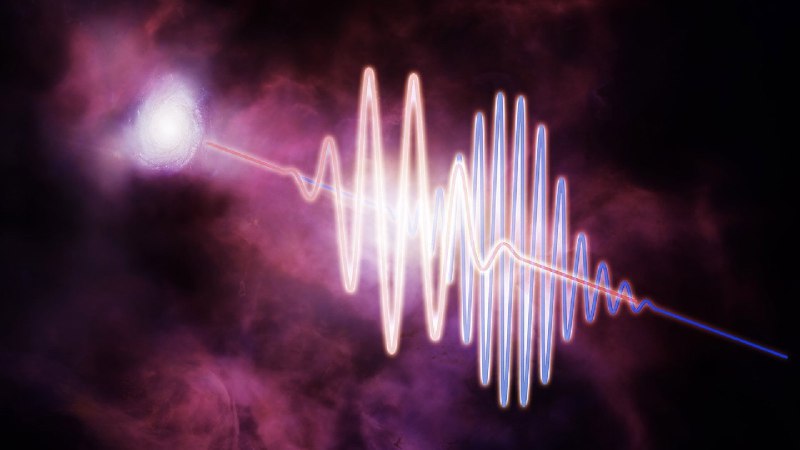
Only in recent years have fast radio bursts (FRBs) been used as a way to look for this matter. FRBs are intense, short bursts of radio waves from deep space that help probe invisible regions of the Universe. As a result of analyzing these bursts, researchers concluded that about 76% of ordinary matter is hidden in hot gas between galaxies, 15% is in gas in the outskirts of galaxies, and the rest makes up stars and planets.
The results align with cosmological calculations: if the matter were truly missing, scientists would have had to revise models of the Universe. The discovery will help researchers better understand the structure and evolution of the cosmos, since matter affects gravity and the formation of galaxies. In addition, searching for “invisible” matter requires new telescopes and analytical methods, which drives advances in technology and science. And the fact that FRBs themselves are still not fully understood keeps the cosmic mystery all the more intriguing.