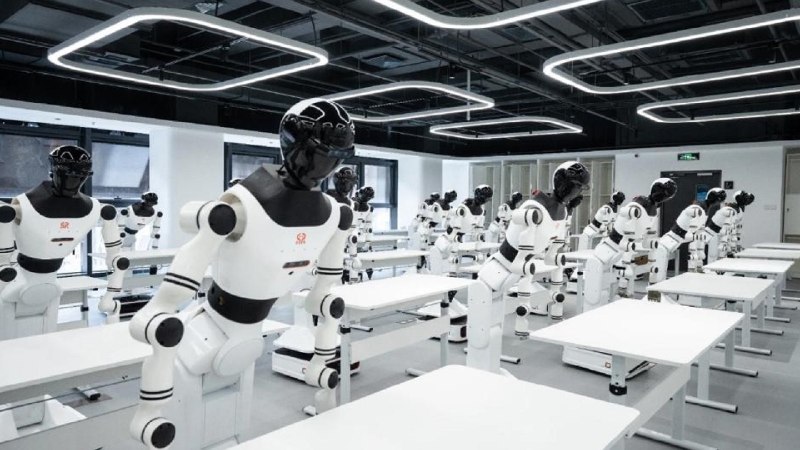
In Beijing, a place has opened that looks more like a hybrid of a university, a factory and a dream apartment — the Phase II Beijing Humanoid Robot Data Training Center. On two floors, production lines sit alongside kitchens, living rooms and other human-style spaces. The “students” here are humanoid robots.
They perform dozens of tasks: sorting cable spools, packing parcels, cleaning rooms and even cooking. The setting changes all the time — today you work in a warehouse, tomorrow you are already learning in the kitchen.
The head of the center explains the approach simply: robots learn the way children do — through repetition. Lots of repetition. Very lots of it. For example, to simply place a frying pan on the stove correctly, it sometimes takes more than a thousand attempts. Thanks to this, the robots perform more than 95% of operations without errors. Some “graduates” of the center are already working in the automotive industry, delivering parcels and helping at energy facilities.
The center’s key idea is to collect as much real data as possible. Not laboratory data, but living data, with mistakes, failures and surprises. This is exactly what artificial intelligence lacks today: variety of situations. The center is connected to similar sites in Suzhou, Jinan, Hefei and Zhengzhou. Together they form, in effect, the largest “school of life” for robots.
People used to admire how a robot looked and moved. Now the main question is whether it can do something useful. And more and more often the answer is: yes, it can. It just needs a little time... and a thousand attempts for each movement.