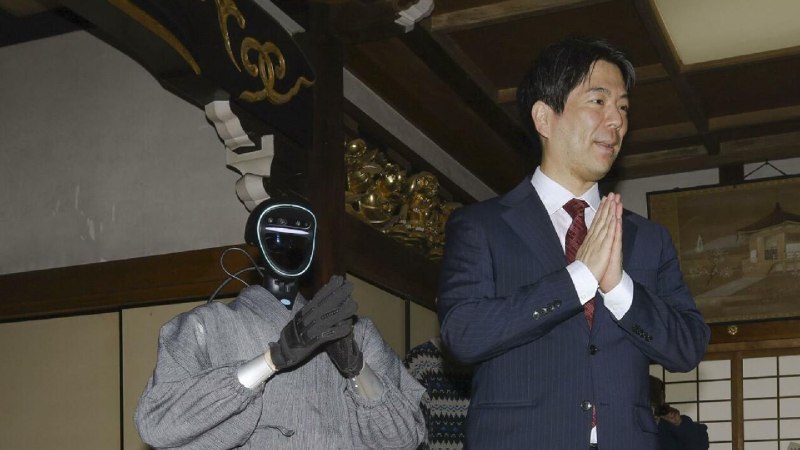
If it seemed that artificial intelligence had already tried everything, the Japanese have added another item to the list: spiritual guidance. At Kyoto University, Buddharoid was introduced — a robot monk trained on Buddhist sacred texts that does not merely talk, but tries to behave as if it were truly part of temple life.
The project uses language neural networks, OpenAI ChatGPT, and the Unitree G1 humanoid robot. But the most interesting part is not the hardware or the code, but the way it is all put together. Buddharoid does not simply answer questions. It bows, takes prayer poses, moves with characteristic restraint, and speaks in a soothing tone. At a demonstration in a temple, Buddharoid calmly spoke with guests, advised them not to give in to emotions, and not to rush into decisions.
Buddharoid is not the first "digital monk" in Japan. Back in 2019, the Kodaiji Temple in Kyoto introduced Mindar, a robot with an aluminum body, a silicone face, and the ability to deliver sermons. But while Mindar mainly spoke, Buddharoid goes a step further — it is learning body language. And in religious practice, that is almost half the meaning: sometimes a bow says more than words.
Japan today is living at the pace of quiet but tangible changes: the population is aging rapidly, and young people are increasingly choosing life in large cities. For temples, this means not only fewer worshippers, but also a gradual decline in young monks, especially in rural areas. The developers take a rather pragmatic and even somewhat bold view of this: in their assessment, such robots may in the near future be able not only to assist, but also independently perform certain rituals. It sounds like the plot of a movie, but it seems to be becoming reality.