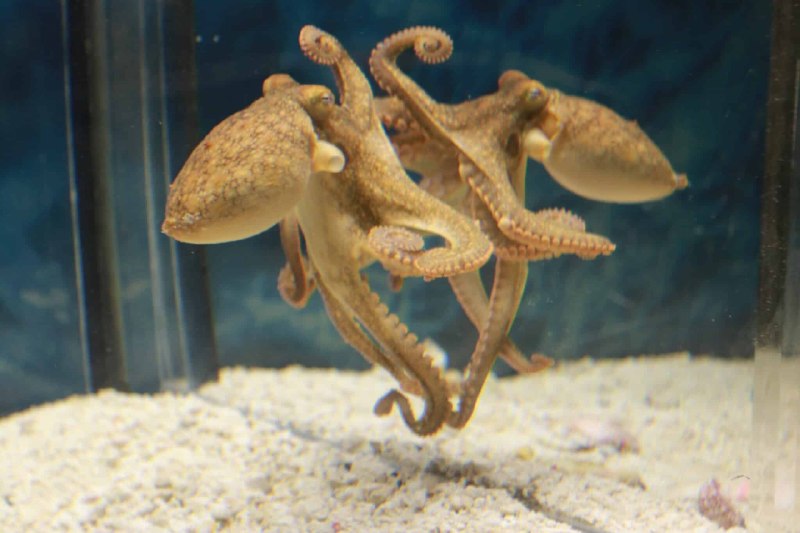
Octopuses have demonstrated for the first time an ability to use a mirror reflection to find hidden prey — a behavior previously confirmed only in vertebrates. A Dartmouth College study showed that California two-spot octopuses can orient themselves by reflection and find the correct direction to a reward.
In the experiment, three octopuses were placed in a chamber with limited visibility. An image of a crab was visible only in the mirror, while the actual prey was outside the direct line of sight. At first, the animals tried to attack the reflection, but after 10–12 attempts they began using the mirror as a source of information. On average, they chose the correct path in about 73% of cases, and over time they made decisions more quickly.
What was especially interesting was that in 59% of successful attempts, the octopuses chose the shortest route, climbing over the chamber wall. In doing so, they temporarily lost sight of the reflection, which may indicate the formation of an internal representation of space — so-called spatial mapping. Researchers stress, however, that the sample is too small for definitive conclusions, and additional experiments are needed.
The study has already become important for understanding the evolution of intelligence. Although octopuses split from vertebrates more than 520 million years ago and have a completely different nervous system, they may have independently developed similar cognitive abilities. This is another example of how different branches of evolution arrive at similar solutions to complex tasks.