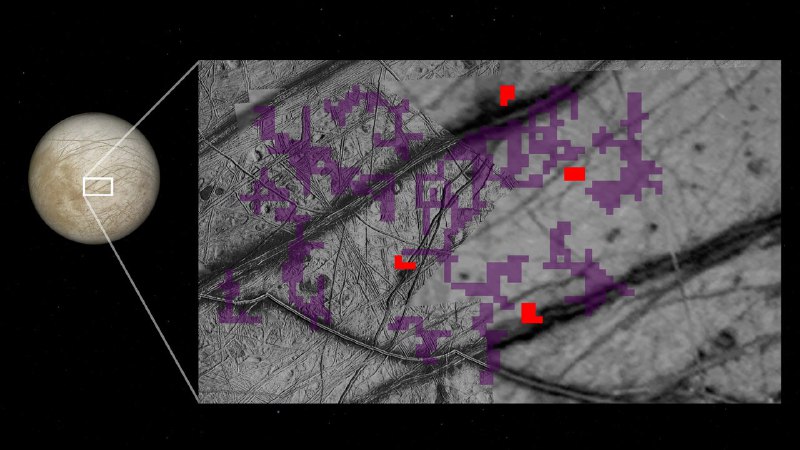
NASA has confirmed the detection of ammonia on the surface of Jupiter’s moon Europa. Traces of the molecule were identified in a reanalysis of data from the Galileo spacecraft collected in 1997.
An infrared spectrometer recorded ammonia signals near cracks in Europa’s icy shell. Its presence on the moon had not previously been confirmed. Ammonia is important for astrobiology: it contains nitrogen, which is needed for organic molecules, and lowers the freezing point of water, increasing the likelihood that a liquid ocean exists beneath the surface.
Scientists think the ammonia may have come from deeper layers or from a subsurface ocean through cracks and cryovolcanic processes. Because the substance is quickly destroyed by radiation, its presence points to relatively recent geological activity.
Further research will be carried out by the Europa Clipper spacecraft, launched in 2024. It is due to reach the Jovian system by 2030 and will study Europa’s surface chemistry, ice structure, and possible plumes from below in detail. If the ammonia is indeed linked to a subsurface ocean, Europa Clipper may be able to confirm that directly.