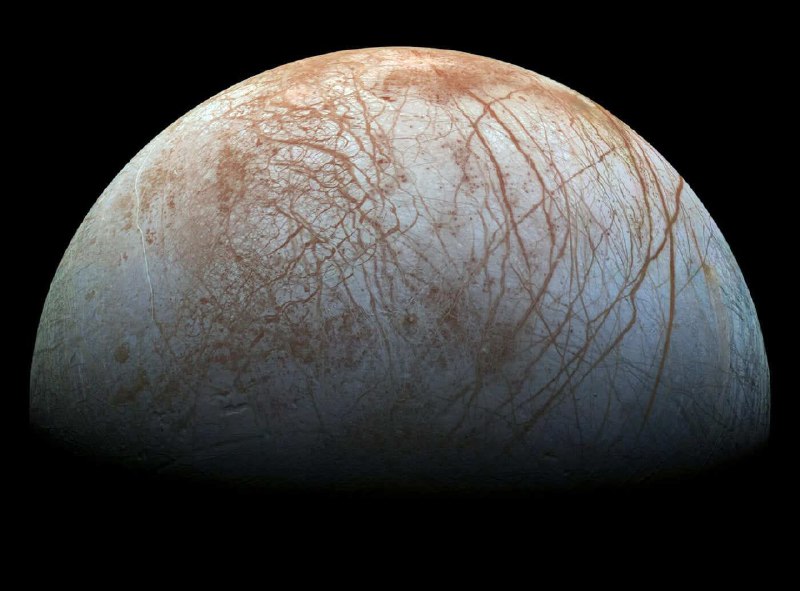
Using the James Webb Space Telescope, an international team observed signs of recently surfaced water on Europa, a moon of Jupiter. In the Tara and Powys regions, they detected fresh crystalline ice.
In Europa’s strong radiation environment, the structure of such ice breaks down within a couple of weeks. This indicates that it either formed very recently or that its structure is continuously being renewed—for example through thermal recrystallization or new water plumes. In addition, in the same areas the team found frozen carbon dioxide containing the rare carbon isotope ¹³C. This suggests that material is being brought up from Europa’s interior, which could be associated with deeper processes or with the breakdown of organic molecules.
Until now, studying Europa has been constrained by data with low signal quality. However, new observations from the NIRSpec spectrograph enabled the scientists to capture such clear signs of fresh ice for the first time.
These discoveries support the idea that active processes are taking place inside Europa and reinforce the hypothesis of a subsurface ocean. The Europa Clipper mission, launched in October 2024, may bring even more surprises.