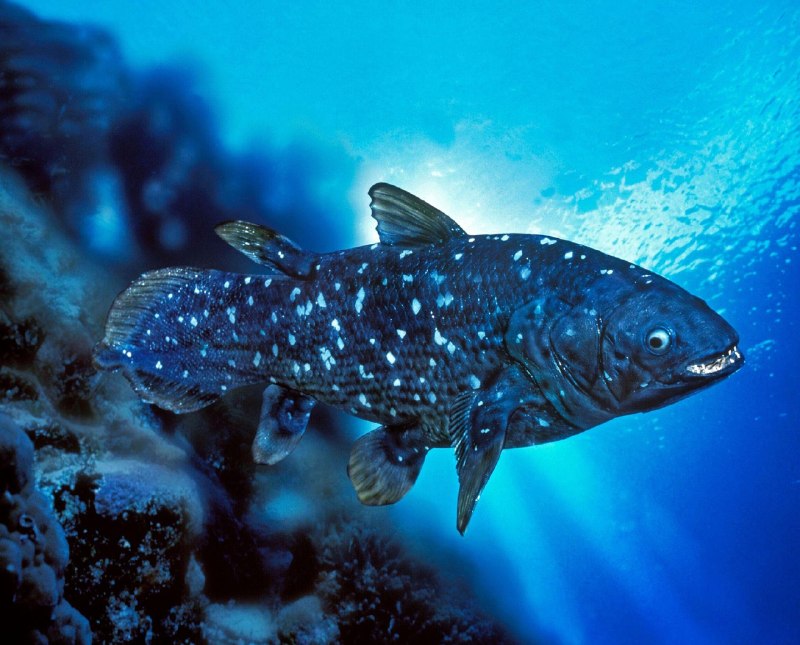
The coelacanth is a rare deep-sea fish that has changed very little over hundreds of millions of years. It was thought to be extinct until one was accidentally caught off the coast of Africa in 1938. Since then, the coelacanth has become something like a living archive of evolution for scientists — and it still manages to surprise.
The fish belongs to the lobe-finned group, from which all land vertebrates, including us, evolved. Coelacanths have unusual fleshy fins that resemble the beginnings of limbs. That is why they are often called relatives of the first animals to come onto land. New research adds another unexpected detail to this story: the ancestors of coelacanths may have used lungs not only for breathing, but also for perceiving sound.
Scientists studied fossils about 240 million years old and found unusual bony outgrowths inside the lungs — which they called “chamber wings.” The researchers think that a gas-filled lung could have picked up vibrations in the water, that is, sound. Those vibrations were then transmitted through channels to the inner ear. In effect, the lung worked like a simple underwater microphone.
In modern coelacanths, the lung has become greatly reduced and is almost nonfunctional, after they moved to the deep and stopped surfacing for air. But channels connected to hearing have been preserved. For a long time, it was unclear why they were needed. Now there is an explanation: in ancient forms, the lung was larger and located closer to the ear, helping them perceive sound.
If the hypothesis is confirmed, it will change our understanding of the origins of hearing. It suggests that the ability to detect sound may have appeared in water — long before the familiar ears with eardrums. And once again, the coelacanth finds itself at the center of attention. This “living time machine” helps us understand not only how fish came onto land, but also how our sense organs took shape.