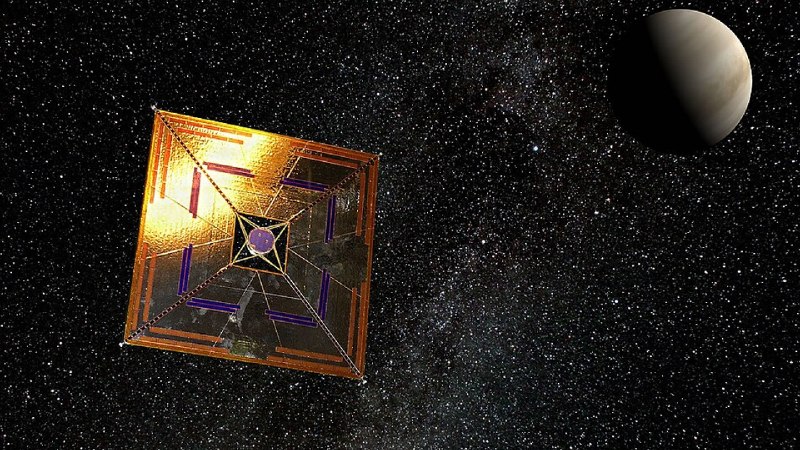
The idea of flying on the “wind of light” is not science fiction, but a workable concept already being tested in space projects. However, light sails have faced a serious problem so far: they overheated and gradually degraded under laser radiation.
Light sails generate thrust through photon pressure and are considered an alternative to traditional fuel-powered rockets. For example, the Breakthrough Starshot project envisages accelerating microprobes with lasers from Earth to 20% of the speed of light, with a flight to Alpha Centauri taking about 20 years. However, such missions have been limited by the lack of a durable sail material.
Scientists at Tuskegee University in the United States have presented a new type of light sail based on a photonic crystal — a nanostructured material that reflects light more efficiently and hardly heats up at all. It uses photon pressure to create thrust and allows motion without fuel. The new material, made of germanium, air and polymer, forms a structure that reflects strictly specified wavelengths. Such a sail can accelerate to hundreds of meters per second in about an hour.
In recent years, interest in fuel-free ways of moving through space has been growing. But overheating remained one of the main engineering barriers. The shift from metal coatings to photonic crystals may be the step that moves the technology from experimental to practically usable.