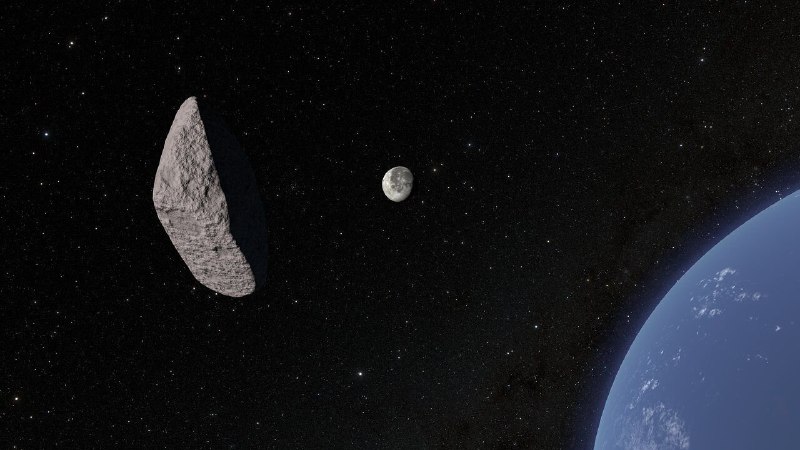
The asteroid 2024 YR4, which until recently was considered potentially dangerous to Earth and the Moon, will in the end simply pass by.
The story began in December 2024, when it was detected by the ATLAS sky-survey system. It is about 60 meters across — roughly the height of a twenty-story building. A space rock of that size is not harmless: if an object like this were to hit Earth, the consequences could be serious. Depending on where it landed, the impact could cause destruction over a large area or, for example, a powerful tsunami.
At first, calculations after its discovery showed a small but still noticeable 3% chance of a collision with Earth in December 2032. Fortunately, later calculations quickly showed that it does not threaten Earth. But another scenario remained: the asteroid could hit the Moon. The probability of that event was estimated at about 4.3%. An asteroid strike on the Moon could have created a new crater, and debris thrown out by the impact could theoretically have produced a rare sight on Earth — a kind of “lunar meteor shower.”
To calculate its path precisely, new information was needed. From February 18 to 26, the James Webb Space Telescope observed the asteroid, and astronomers were able to obtain highly accurate data. The verdict was as calm as possible: 2024 YR4 will pass about 21,200 km above the Moon’s surface — far enough to rule out any collision.
For the Moon, that means no new crater. For Earth, it means no hypothetical “lunar fireworks.” And for science, it is a great example of how modern systems for observing near-Earth objects work.