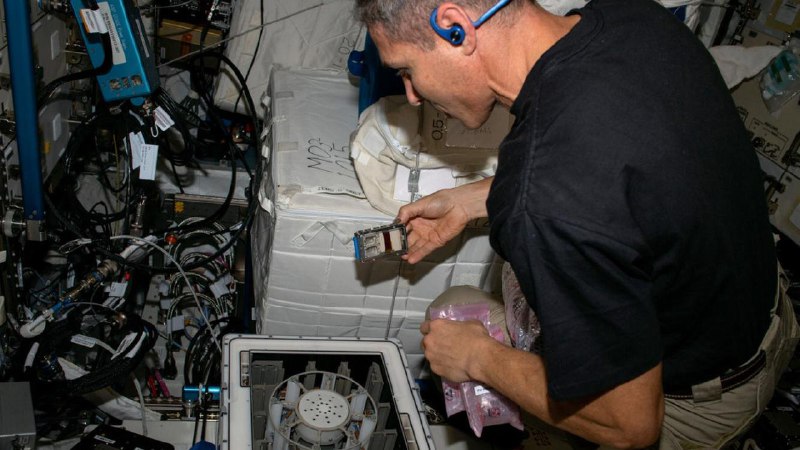
On board the International Space Station, precious metals were successfully extracted from meteorites for the first time using microorganisms. The experiment was carried out by NASA together with scientists from Cornell and the University of Edinburgh, and it was performed in orbit by astronaut Michael Scott Hopkins. The researchers used meteorites of the L-chondrite class, which are considered a promising source of useful minerals for future space missions.
The scientists tested two bioleaching methods — with bacterial cultures and with the fungus Penicillium simplicissimum. Both approaches rely on microorganisms releasing organic acids that help separate metals from the mineral rock. The fungus produced the most notable result: in microgravity, it extracted platinum and palladium more effectively.
This is especially important because ordinary chemical leaching without microorganisms in space produced weaker results than on Earth. In other words, weightlessness did not become an obstacle to the biotechnology and, in some cases, even increased its usefulness.
The work opens the way to extracting needed materials directly in space — on asteroids, the Moon, or other bodies — without constantly delivering rare metals from Earth. For future long-duration missions, this could mean significantly lower costs and a more environmentally friendly approach to using local resources. It seems the space industry has gained a new unexpected ally: microorganisms.