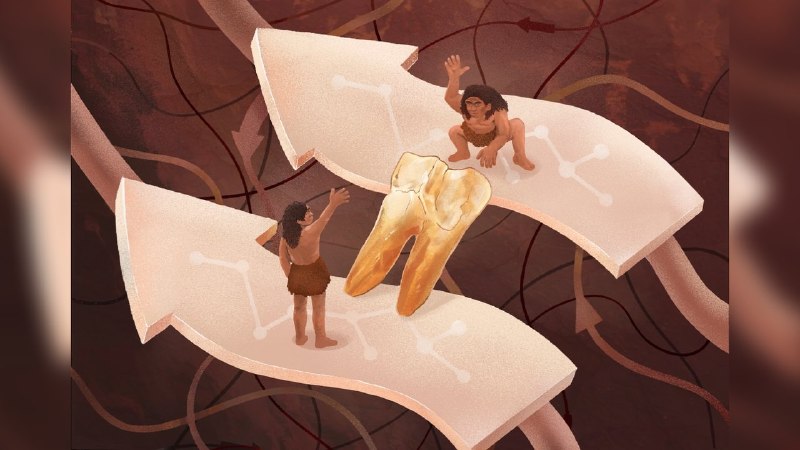
Scientists have obtained genetic information from Homo erectus for the first time — one of the most successful and longest-lived species of ancient humans. The study was based on the teeth of six Homo erectus individuals, about 400,000 years old. DNA degrades almost completely over such a long period. For that reason, the scientists used a different approach — paleoproteomics. This method makes it possible to reconstruct genetic information from preserved proteins, which are much more stable than DNA molecules.
From the enamel, researchers isolated 11 proteins and identified hundreds of amino acids. Among them were two particularly important variants: one proved to be unique to Homo erectus, while the other matched a variant previously found in Denisovans. It is known that this genetic trait later appeared in part of modern humans as a result of ancient population interbreeding.
This is the first direct evidence of deep genetic links between Homo erectus, Denisovans and modern humans. Homo erectus occupies a special place in human history. This species appeared about 1.8 million years ago, was the first to leave Africa and spread across vast regions of Europe and Asia. Its representatives created fairly complex stone tools, had relatively large brains, and survived for more than a million years — longer than many other human species.
The historical context makes the discovery especially important. The Middle Pleistocene — roughly from 774,000 to 129,000 years ago — has long been considered one of the most difficult periods of human evolution to understand. During this time, Homo erectus, early Homo sapiens, Neanderthals and Denisovans all existed at the same time. Because of the lack of data, researchers even called this stage an "evolutionary mess." The new study shows that this complexity reflected the real picture of the past, where different groups of ancient humans interacted much more actively than previously thought.