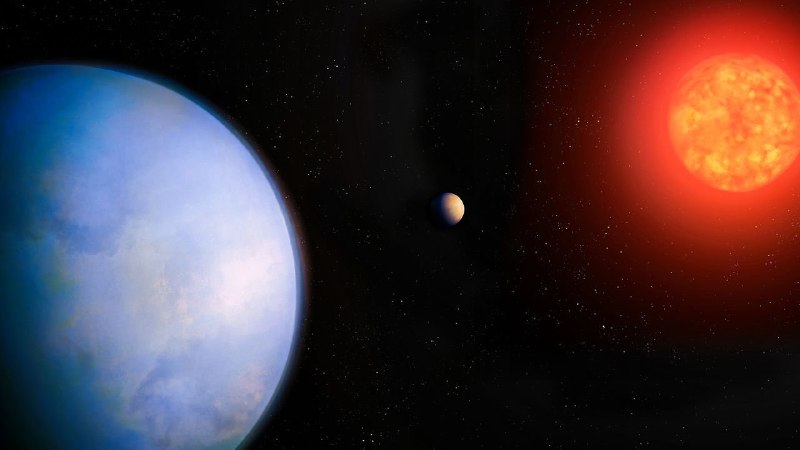
Astronomers have discovered a new exoplanet — GJ 251c — just 18 light-years from Earth. This rocky world is about four times more massive than Earth and lies in the habitable zone of its star, the red dwarf GJ 251 in the constellation Gemini. That means that, if the planet has an atmosphere, it may have liquid water — a key condition for life.
The discovery is the result of more than 20 years of observations: researchers tracked the star’s tiniest “wobbles” caused by the planet’s gravity using the high-precision spectrographs HPF and NEID. To isolate the planetary signal, the researchers first modeled its behavior and then compared the data with real observations — without this work, the discovery would not have been possible.
GJ 251c is more attractive than other nearby exoplanets because it lies in the habitable zone of a relatively stable red dwarf, where there is less risk that flares will damage its atmosphere. Its orbit is at a safe distance, and the planet is close enough to Earth that in the coming decades it may be possible to study its atmosphere with new, more powerful telescopes. This makes it one of the most promising targets in the search for life beyond the Solar System.