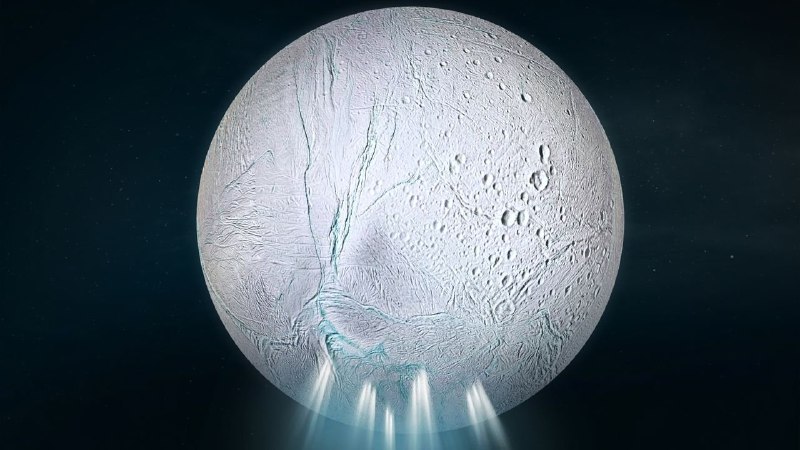
In the geysers of Enceladus — Saturn’s icy moon — complex organic molecules similar to those involved in biochemical processes on Earth have been detected. The data were obtained through a reanalysis of information from the Cassini spacecraft, which ended its mission in 2017.
Cassini’s instruments recorded substances — esters, alkyls, and nitrogen- and oxygen-containing compounds — as it passed through geysers erupting from beneath the icy crust. The key finding is that these substances were found not only in Saturn’s E ring, but also in fresh geyser ejecta, indicating that they originate from Enceladus’s deep ocean rather than from the external environment or radiation effects. This strengthens the hypothesis that there may be an environment beneath the moon’s surface that could potentially support life.
At the same time, some organic compounds may still form directly on Enceladus’s surface. A definitive answer will require a direct sample of the ice. The European Space Agency is already considering a mission to land a probe on Enceladus in 2054 — an ambitious step that could bring us closer to discovering life beyond Earth.