The University of Tokyo has made an important announcement: possibly for the first time in the history of astronomy, direct evidence has been obtained for the existence of dark matter — the mysterious substance that makes up as much as 85% of all matter in the Universe. Until now, its presence had been confirmed only indirectly, through gravitational effects.
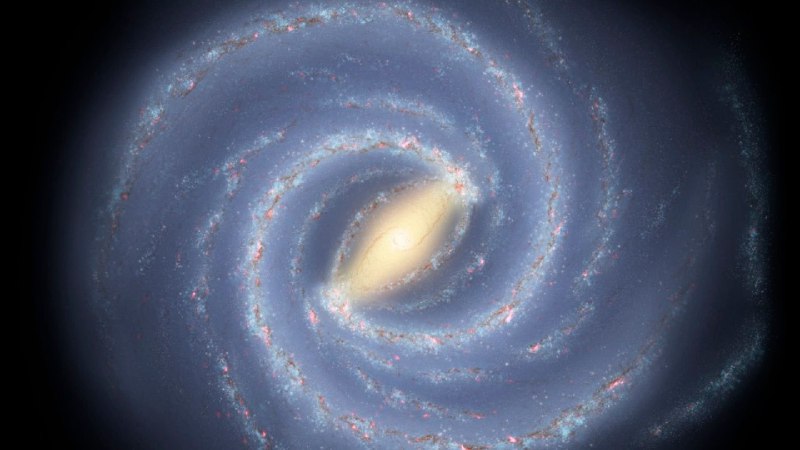
The Fermi telescope detected bursts of gamma radiation with colossal energy — up to 20 GeV — coming from the center of the Milky Way. That is precisely where, according to calculations, a significant amount of dark matter is concentrated. The shape and distribution of the gamma-ray bursts match theoretical models describing the behavior of weakly interacting massive particles (WIMPs) with remarkable precision. These particles are considered the main candidates for the “building material” of dark matter.
Of course, despite the fact that the observed radiation cannot be explained by known cosmic sources, verification is needed before speaking of a definitive discovery. Astronomers hope to obtain similar signals from other objects with high dark matter density, such as dwarf galaxies.
The existence of invisible mass was first proposed in the 1930s by astrophysicist Fritz Zwicky, who studied the motion of galaxies. And now, almost a century later, science has come very close to solving this great cosmic mystery.