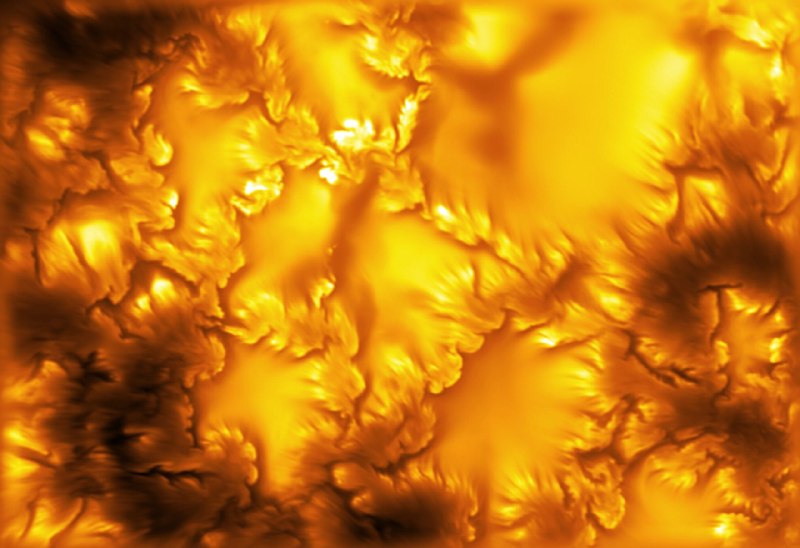
Astronomers have directly seen plasma vortices on the surface of the Sun for the first time — structures ranging in size from 25 to 170 kilometers. The observations were made with the world’s largest solar telescope, the Daniel K. Inouye Solar Telescope.
This is especially interesting in light of one of the main mysteries of solar physics: why is the corona much hotter than the surface? The photosphere is heated to about 5,500°C, while the temperature of the corona reaches 1–3 million °C. Imagine moving away from a campfire and finding that it gets only hotter. Physicists have been trying to solve this paradox for more than 80 years.
Scientists studied 47 vortices. They form within several dozen seconds and move at speeds of up to 3 km/s. According to the researchers, they are caused by the Kelvin-Helmholtz instability: neighboring plasma flows move at different speeds, and the boundary between them begins to twist.
The vortices can merge into larger structures, but at the same time they generate smaller-scale swirls. This cascade of motion forms turbulence, helping to transport energy and magnetic flux. This is not yet the solution to the mystery of coronal heating, but for the first time scientists have seen one possible mechanism right where it happens, rather than only in computer models.