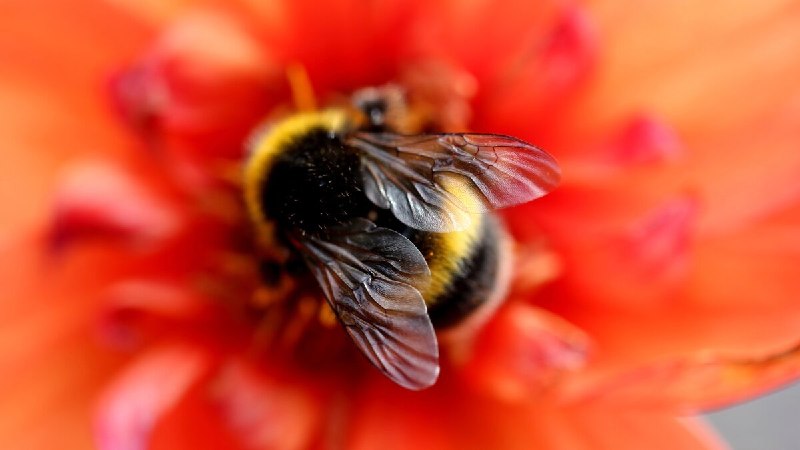
Researchers from the universities of Oulu, Helsinki and Turku have presented the results of an experiment showing that bumblebees can independently find solutions to completely new tasks without relying on prior experience, training or hints.
In the experiment, the insects had to figure out how to move a ball under an artificial flower in order to gain access to a sweet treat. The bumblebees already knew that the flower contained a sweet reward, but during the test it was not directly accessible. Nevertheless, many of them managed to work out the correct sequence of actions. The task resembles the classic “box and banana” test, which has long been used to study the intellectual abilities of vertebrate animals.
To check the results, the conditions were made more difficult. When the flower was hidden from view, 16 of 22 bumblebees still found the solution and reached the reward. In another trial, 23 of 30 individuals made the correct choice, which is significantly above the probability of a random success.
The authors of the study stress that this does not mean bumblebees think like humans. The experiment revealed cognitive flexibility in them — the ability to adapt to new circumstances and find effective solutions without a pre-set behavioural algorithm. The study adds to a growing body of evidence on the complex behaviour of insects and shows that even creatures with very small brains can display unexpected intellectual abilities.