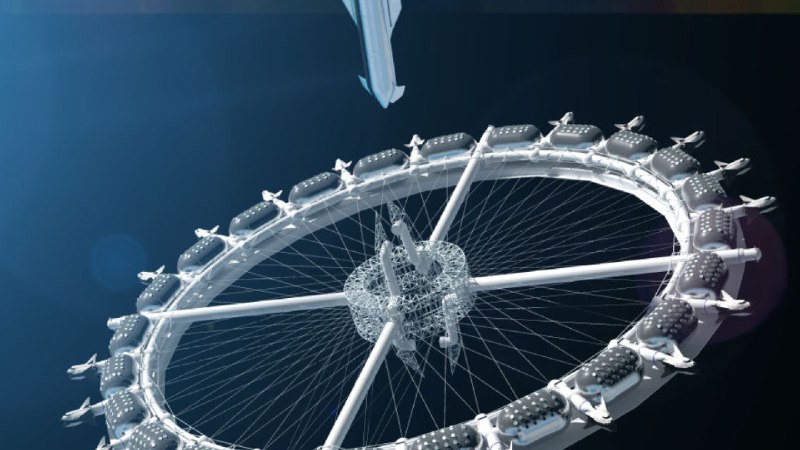
The Russian space corporation Energia has patented a design for a rotating orbital station with artificial gravity. It is a technological response to a long-standing problem of all long-duration space missions: how to preserve astronauts’ health in weightlessness.
The project is based on the centrifuge effect — the station’s rotation creates a pull comparable to Earth’s gravity. The design specifies a force equal to half of Earth’s gravity, which is enough to help maintain muscle tone and bone density.
The station design is modular, with a rotation radius of 40 meters and a speed of 5 revolutions per minute. The living modules are connected to the axis by flexible passages, ensuring airtightness and safety.
The patent was filed as Russia prepares to leave the ISS project and build its own orbital platform, with plans to transfer the Nauka and Prichal modules there. Although there is no precise implementation timeline, this is an important step in the development of autonomous space infrastructure and international competition in orbital stations.