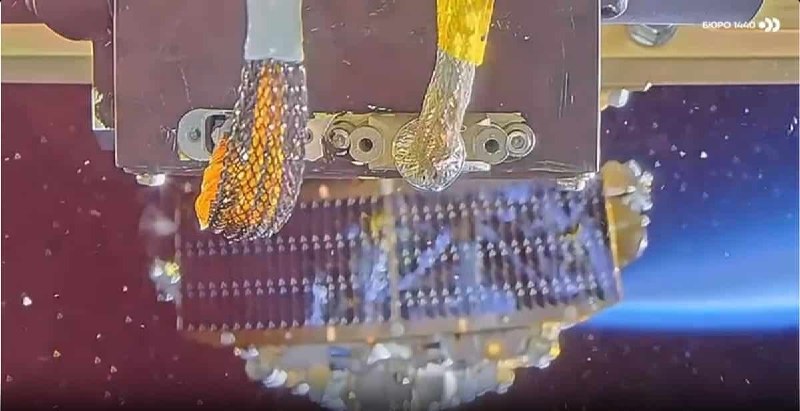
Bureau 1440 has placed 16 satellites of the Rassvet project into orbit. This stage marks the transition from testing to the formation of a full orbital network. The spacecraft were delivered by a Soyuz-2.1b rocket, successfully separated, and came under control.
For the first time, a group of satellites capable of operating as a single system has been formed. This makes it possible to test the project’s key technology — inter-satellite laser communication at speeds of up to 10 Gbps, which reduces dependence on ground infrastructure and provides coverage in hard-to-reach regions. The satellites operate at an altitude of about 800 km and support the 5G NTN architecture. This makes it possible to integrate satellite internet into familiar mobile networks. The stated characteristics are speeds of up to 1 Gbps and latency of up to 70 ms.
The Rassvet satellite system has broad practical significance — from supporting emergency services to providing communications at industrial sites and in hard-to-reach conditions. Its role is especially important for remote regions — the Arctic, Siberia, and the Russian Far East, where traditional infrastructure is poorly developed or economically impractical. In such areas, satellite communications become not an alternative, but a basic communications access technology.
Rassvet is only beginning to scale up. In 2026, 156 spacecraft are planned for launch, and in 2027 nearly 300, with the commercial service starting at the same time. However, this is the beginning of building a new infrastructure on which communications, transport, and industry will depend in the future.