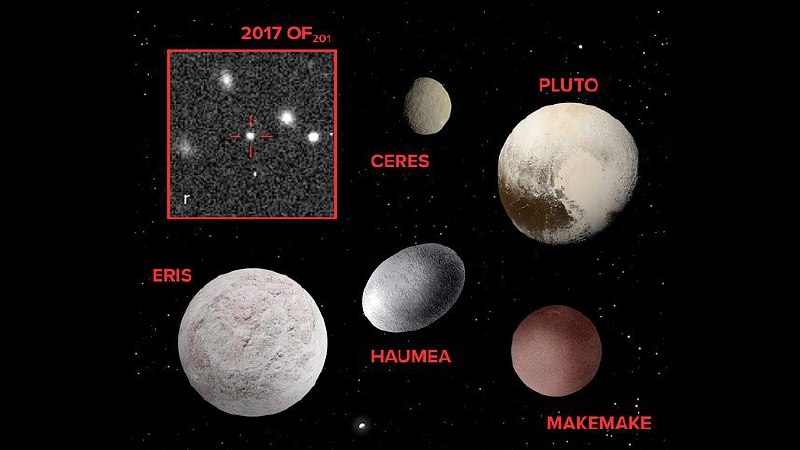
In the most distant region of the Solar System, astronomers have identified a dwarf object, 2017 OF201—an announcement already described as one of this year’s notable moments in astronomy. The International Astronomical Union has officially confirmed the object, which completes a full orbit around the Sun in almost 25,000 years.
The new celestial “resident” is a roughly spherical body about 700 kilometers in diameter—nearly half the size of Pluto. What makes it especially interesting is its exceptionally elongated orbit, which differs from most known trans-Neptunian objects. The object is only observable along about 1% of its orbit, and it is this limited visibility that for many years made it difficult to detect.
The object was first recorded in 2017, but its existence was confirmed only now, after analyzing archival images from two telescopes taken over seven years. Its unique orbital characteristics do not fit existing scenarios for the behavior of such bodies, raising questions about some hypotheses, including the popular idea of “Planet 9.” New observations and data may help reveal more of the mysteries of the far outer regions where science is only beginning to chart its way.