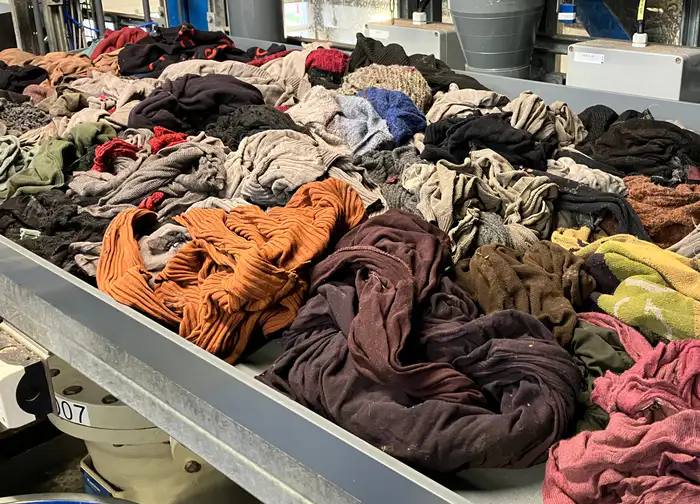
The textile industry produces millions of tonnes of waste every year and remains one of the most polluting sectors. However, researchers in several countries have presented new technologies that could make the industry more environmentally friendly.
British researchers have created an innovative fabric called SWEET (Smart, Wearable, and Eco-friendly Electronic Textiles), which combines graphene sensors with the biodegradable material Tencel, made from wood fibre. The new fabric can measure heart rate and temperature, and after disposal it breaks down in soil without harming the environment. Its production also uses inkjet printing, reducing water and energy consumption.
Scientists at the University of Amsterdam have developed a method for recycling poly-cotton fabrics. Using concentrated hydrochloric acid, they have learned to separate the cotton component and turn it into glucose, which can serve as a basis for biodegradable plastics and biofuel. The remaining polyester retains its properties and can be used to make new fabrics. This is significantly more environmentally friendly than traditional recycling methods, which rely on mechanical shredding or incineration.
Researchers at Germany’s Jülich Research Centre have proposed another solution: recycling nylon with the help of Pseudomonas putida bacteria. These microorganisms break down complex nylon molecules, turning them into biopolymers suitable for making biodegradable plastics. This method can help reduce pollution caused by synthetic materials.
Austrian scientists have found a way to turn old clothes into packaging. They process cotton fibres into cardboard containing 30% textile fibres. This material is stronger than standard packaging paper and is a more environmentally friendly alternative.
These innovations show that combining science and technology can move the textile industry towards a more sustainable model. New recycling methods can not only reduce the amount of waste, but also create a closed-loop system in which textiles get a second life in many different forms.
Sources: Good News Network
University of Amsterdam
New Scientist
TU Graz