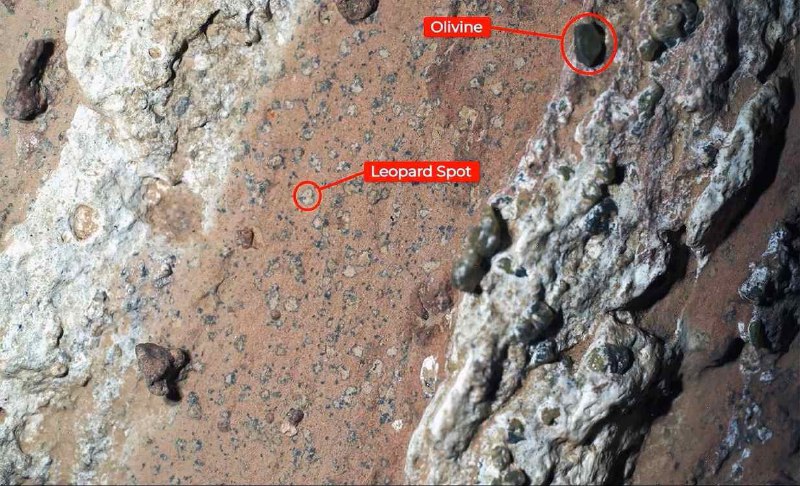
Mars rover Perseverance discovered two rare minerals — vivianite and greigite — in a core sample. On Earth, they almost always form with the involvement of microorganisms. This discovery in Neretva Vallis, an ancient channel that fed into Jezero Crater, is considered by scientists to be one of the most significant in the search for signs of life beyond Earth.
Greigite forms, among other things, thanks to bacteria that process sulfates and respond to magnetic fields, while vivianite is often found in places where organic matter decomposes — for example, in fossils. Their joint presence in Martian rock may point to possible biosignatures, although this is not yet conclusive proof.
NASA plans to carry out more detailed analysis to understand whether the minerals could have formed without the involvement of living organisms. Meanwhile, the agency is changing strategy: instead of robotic delivery of samples from Mars, a crewed mission will be organized.
This discovery is not just a find, but a possible turning point in the history of science: a chance to move closer to the answer to a question that has fascinated humanity for centuries — was there life on Mars?