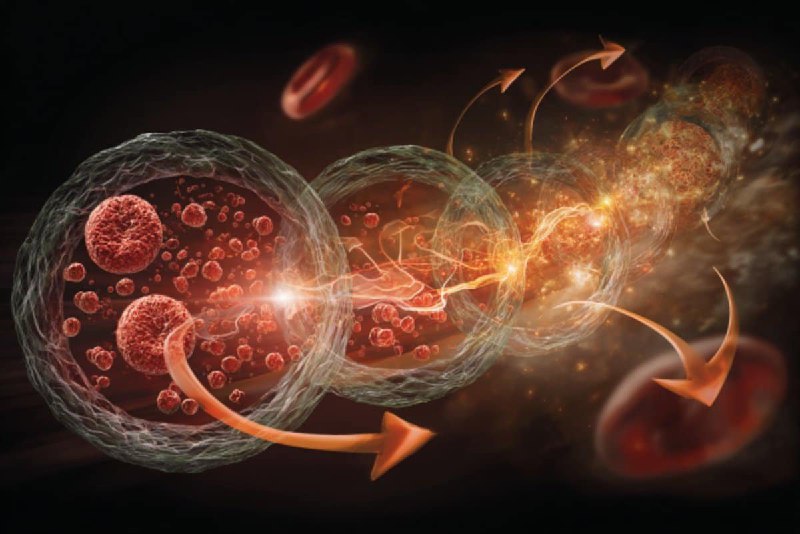
A study from the College of Medicine at Korea University has provided evidence that aging is not only the result of what happens in individual cells, but a complex process that can be transmitted across the body through the blood. A central role in this process is played by the protein ReHMGB1: released by senescent cells, it triggers aging in other, still “younger” tissues, worsening their condition and regeneration.
Earlier research suggested that aging-related effects are transmitted only between neighboring cells, but this new work shows that blood becomes a universal carrier of these signals. In experiments, antibodies were used to block this protein in mice. As a result, signs of cellular senescence were reduced, while recovery and physical activity after injuries improved.
This discovery may shift approaches to regulating age-related changes: instead of acting only at the level of individual cells, it may be possible to influence a systemic mechanism of aging. If it becomes possible to create drugs that block ReHMGB1, it could allow slowing aging in tissues and extending active longevity. In the context of a rapidly aging population worldwide, these results are especially valuable.