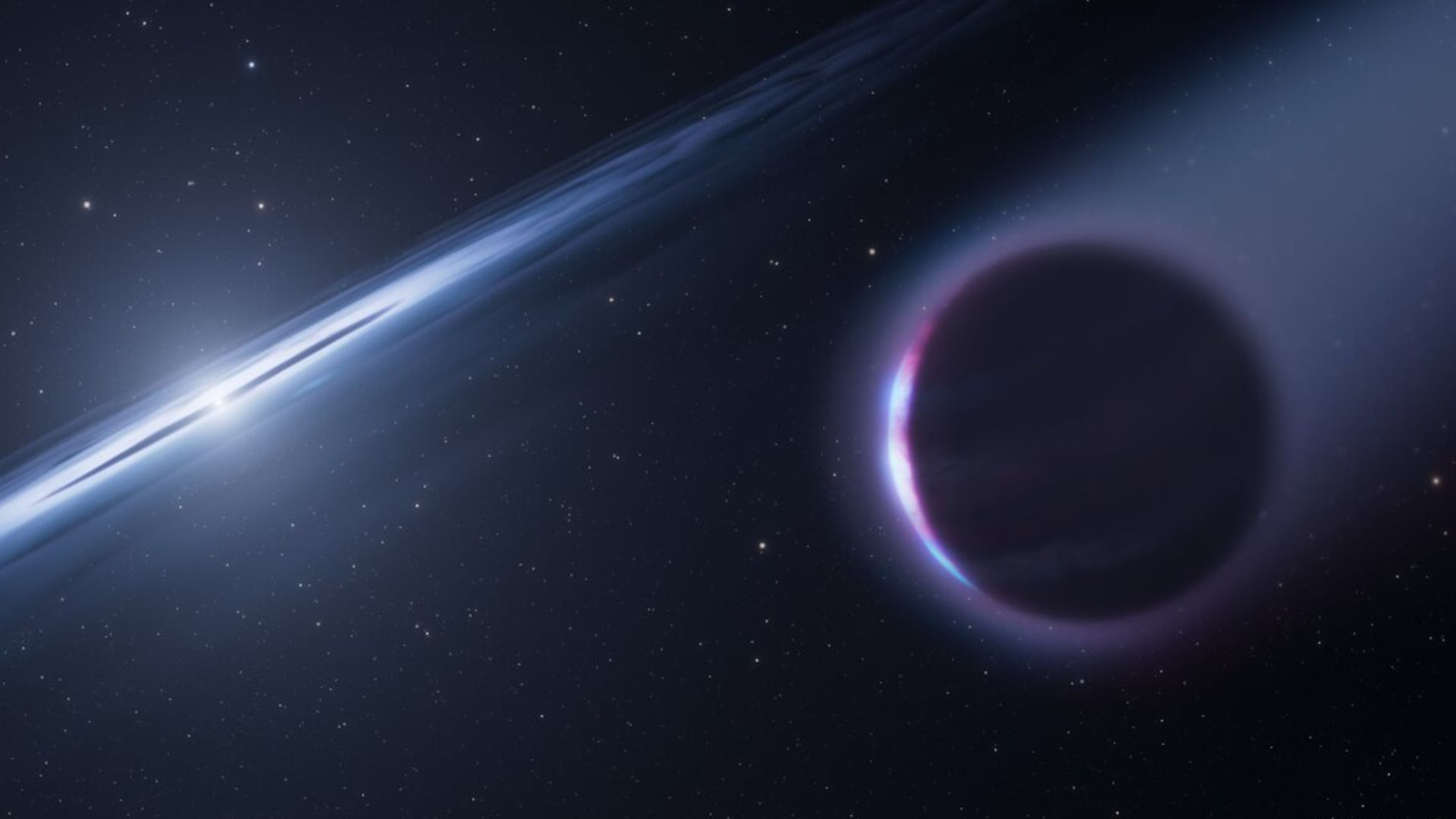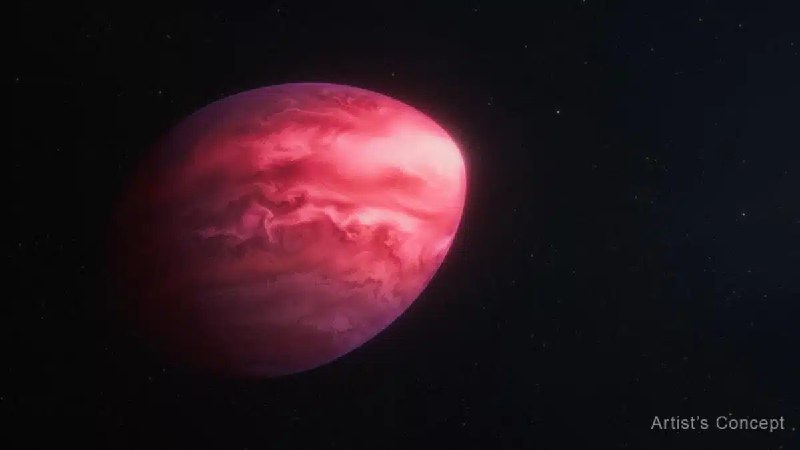
An international team of astronomers, using the James Webb Space Telescope, has discovered an exoplanet that looks and behaves unlike anything known in terms of its shape and atmospheric composition.
The planet PSR J2322-2650b orbits a pulsar — the ultra-dense remnant of a star — with an incredibly short period of just 7.8 hours. It is a gas giant примерно the size of Jupiter. Under the influence of extreme radiation from the pulsar, the planet has been stretched into an elongated shape. It now looks like a giant lemon.
The planet’s atmosphere is a true scientific sensation. It is almost completely lacking the usual elements found in planetary atmospheres: hydrogen, oxygen and nitrogen. Instead, it contains molecules of pure carbon. Such a composition does not fit existing theories of planet formation. Even scenarios involving the destruction of stars or the formation of “carbon stars” do not explain how an object with such a chemical imbalance could appear. By all textbook standards, it should not exist.
Intense gamma radiation from the pulsar heats the atmosphere to temperatures above 2,000 °C on the day side and about 600 °C on the night side. This creates powerful, mainly westward winds. Until now, models had predicted dominant eastward flows under similar conditions.
PSR J2322-2650b is the first confirmed example of an exoplanet with a unique shape and atmosphere. This “space lemon” does more than add color to the exoplanet catalog: it calls for astronomical classifications to be rewritten, approaches to chemical modeling to be reconsidered, and perhaps our understanding of what is possible in the structure of the Universe to be rebuilt.