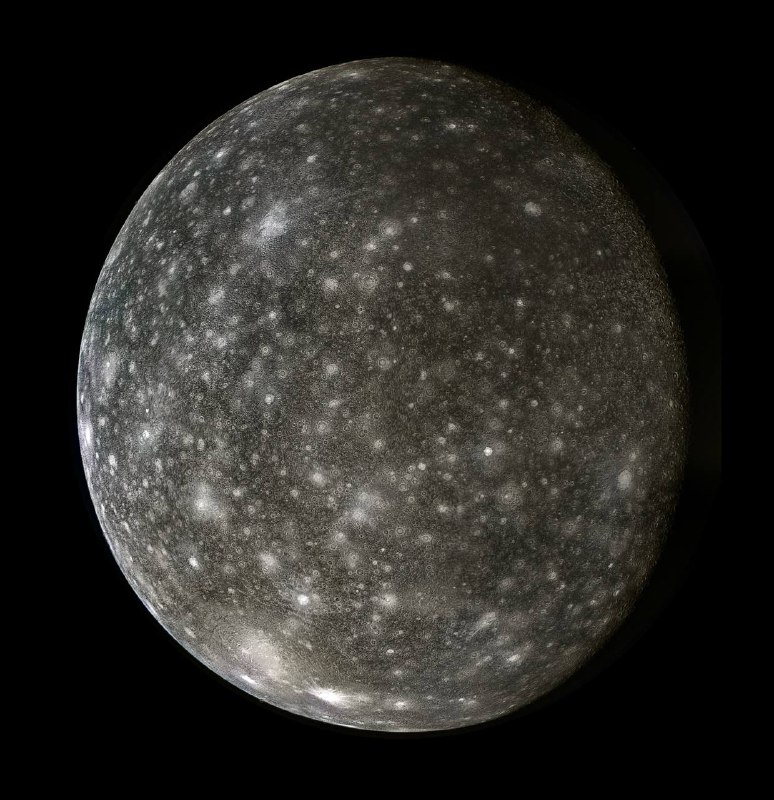
A new study based on data from the Galileo mission found that Callisto’s magnetic field cannot be explained by its ionosphere alone. Instead, scientists suggest that a salty ocean tens of kilometers thick lies beneath Callisto’s icy crust.
Callisto is the oldest and least altered moon in the Jupiter system. Its surface is covered with craters but shows almost no signs of internal activity. This means that if an ocean exists, it is very stable and may have existed for billions of years. The presence of an ocean on another moon of Jupiter, Europa, has long been confirmed, but Callisto’s ocean has remained uncertain. New computational models show that a combination of an icy crust and a deep ocean best explains the observed data.
Future missions, NASA’s Europa Clipper and ESA’s JUICE, which will reach the Jupiter system in the 2030s, will help test these hypotheses. If the ocean’s existence is confirmed, Callisto will become another key object for studying potentially habitable worlds in the Solar System.