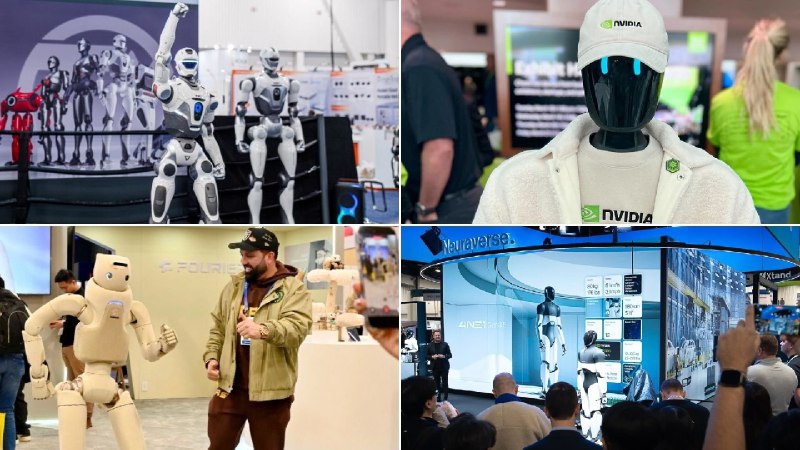
CES 2026 featured noticeably more robots than in previous years — and this was not just a numerical increase, but a qualitative shift in the industry. Where concepts and laboratory prototypes previously dominated, this year’s booths included robots that are already working or will begin work in 2026.
Boston Dynamics introduced the production version of Atlas: 56 degrees of freedom, a payload capacity of up to 50 kg, and AI from Google DeepMind. In 2026, Atlas will begin work at Hyundai in the United States. This is the first case of Atlas receiving a full industrial “job.” Unitree Robotics introduced three models at once: G1, H2 and R1. The focus is on mass production, maneuverability and affordability. CLOiD from LG loads a dishwasher, folds laundry, helps in the kitchen and controls appliances within the LG ThinQ ecosystem. And Dynamis from U.S.-based LEM Surgical is a certified surgical robot already being used in spinal operations.
HMND 01 Alpha from British company Humanoid stood out in particular as the fastest-created humanoid robot. Development took just seven months. This is an almost unprecedented result in an industry where the process usually takes several years. At the exhibition, Alpha was already performing a production task in a factory-like environment.
Overall, it is fair to say that humanoid robots are stepping into the real world.