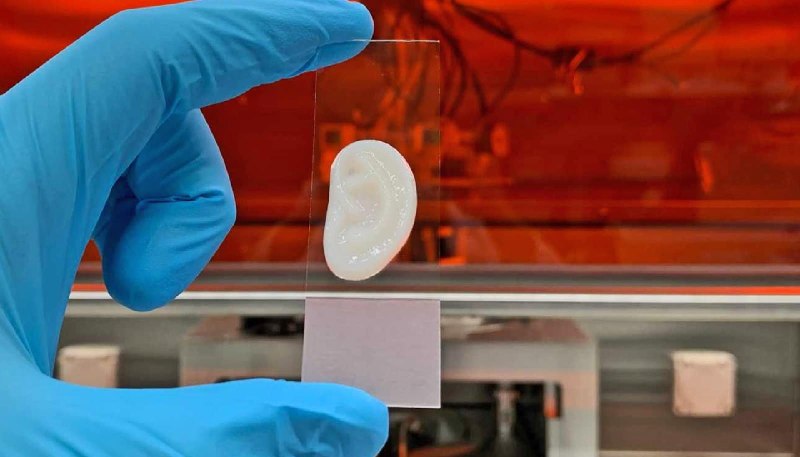
Swiss researchers from ETH Zurich, the Friedrich Miescher Institute in Basel and Lucerne Cantonal Hospital have taken an important step toward creating a human ear in the laboratory. They succeeded in growing ear cartilage from human cells that is close to natural tissue in its mechanical properties — above all elasticity and durability. This is not only a matter of external similarity, but also of functional precision. In other words, the material behaves like real cartilage, rather than merely looking like it.
This was confirmed by experiments: the implanted structures retained their shape and elasticity for six weeks. For bioengineering, this is a key indicator — the tissue must withstand not only the moment of implantation, but also long-term survival in the body. In the course of the work, the researchers extracted cells from a small sample of ear cartilage, multiplied them to hundreds of millions, and used them as part of bioink for 3D printing.
Today, patients who have lost an ear because of trauma or burns, as well as children with congenital microtia, are most often reconstructed using rib cartilage. This is a complex and painful procedure that leaves scars and does not always produce a natural result. The new approach could potentially eliminate these drawbacks: only a small sample of the patient’s own tissue would be needed.