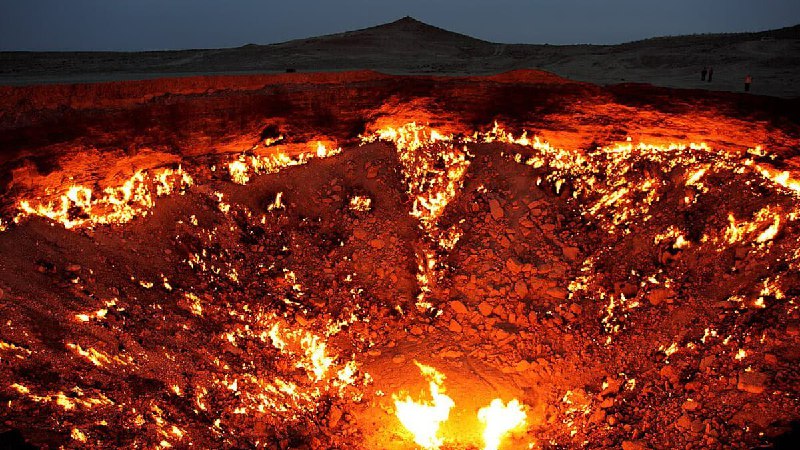
In the Karakum desert in northern Turkmenistan, the famous Darvaza gas crater—“the Gates of Hell”—has been burning for 54 years. Its fiery tongues and futuristic landscape attract tourists from around the world. The crater was accidentally created by Soviet geologists in 1971 during natural gas exploration. To prevent methane from spreading, they set the area on fire.
According to calculations, the fire was supposed to burn out in a few days, but instead it has not gone out for decades, emitting large volumes of greenhouse gas into the atmosphere.
At the TESC 2025 conference in Ashgabat, the state company Turkmengaz said its efforts to reduce emissions are starting to show results: for the first time in the crater’s entire history, there is a noticeable weakening of the flame.
After a presidential decree in 2022, Turkmengaz, together with the UN Environment Programme, introduced drilling and methane capture technology before it is ignited. The captured methane can then be used as a resource rather than being released into the atmosphere.
The crater’s dimming is not only an environmental success for Turkmenistan, but also an example of how modern technology and international cooperation can address problems that once seemed permanent.
Source: New Atlas